Posts

Unless a Grain of Wheat Falls to the Ground

The following is an article I wrote for the January 2016 edition of the Anglican Journal: This past summer, my father-in-law took us to see the church in which he worshipped as a child. Church of the Herald Angel, just outside of Orangeville, Ont., has been closed for many years and is now a well-cared-for home. A workman was repointing the mortar of one of the buttresses when we stopped to take a look. Many churches simply fall into disrepair and eventually vanish. It was good to see this church lived in and loved, and yet, there was a certain sadness in realizing the church no longer served its intended purpose, that the life of its worshipping community had come to an end. It was a bit like visiting the grave of a loved one in a well-tended cemetery; even amidst the beauty of the place, there is a profound and enduring sense of grief and loss. Like the Church of the Herald Angel, many churches across our country have closed or are facing closure. Sometimes those churches are in ...

A Generation Lost?

Image
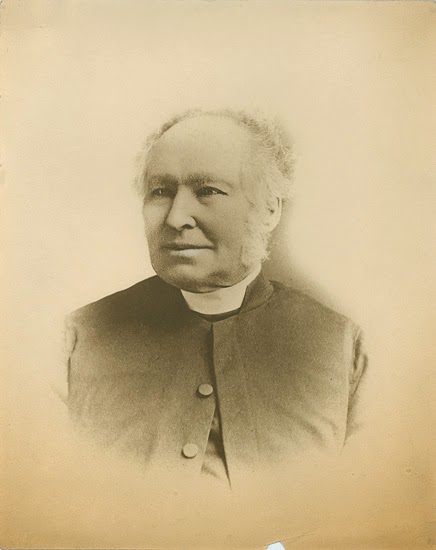
The following is a column I wrote for the March 2015 edition of the Anglican Journal, and is reproduced here with permission of the editor. There was a general feeling amongst the elderly in the community that a whole generation was being lost.  Their adult children had fallen away, and their grandchildren knew nothing of the faith at all.  One of them proclaimed, “O sir … our children are growing up faithless and our little ones have never been baptized!”  This might very easily be the lament of any of our senior parishioners on any given Sunday in one of our churches.  Yet, these were words spoken to the Rev.  Featherstone Osler, the first resident clergyman of West Gwillimbury and Tecumseth in Upper Canada , shortly after his arrival in 1837.  The shortage of permanent resident clergy and the failure to build churches over the preceding thirty years had led to a whole generation of settlers falling away, and their children never coming to faith...

The Good Shepherd

Jesus the Good Shepherd   ‘I am the good shepherd. The good shepherd lays down his life for the sheep. The hired hand, who is not the shepherd and does not own the sheep, sees the wolf coming and leaves the sheep and runs away—and the wolf snatches them and scatters them. The hired hand runs away because a hired hand does not care for the sheep. I am the good shepherd. I know my own and my own know me, just as the Father knows me and I know the Father. And I lay down my life for the sheep. I have other sheep that do not belong to this fold. I must bring them also, and they will listen to my voice. So there will be one flock, one shepherd.’ -John 10:11-16   There can be little doubt in my mind that when Jesus tells his disciples that he is the Good Shepherd, he is clearly and intentionally evoking the image of the shepherd in the Twenty-third Psalm.   In that treasured psalm, in which the Psalmist boldly proclaims, “the LORD is my shepherd,” we learn that thi...

And is it True? A Message for Christmas 2013

“And is it true?” And is it true? And is it true,           This most tremendous tale of all, Seen in a stained-glass window’s hue,           a Baby in an ox’s stall? The maker of the stars and sea Become a child on earth for me? And is it true? As we make our way into our churches or gather round our festive tables this Christmastime, do we believe that the Truth of the image illumined in stained glass is also the Truth that illumines our hearts?   In his poem Christmas, John Betjeman (1906-1984), the late poet laureate of England, utters these words “and is it true?”, as a cry that straddles faith and doubt as he observes the festivities unfolding.   Oh, to be sure, as we look around us during this advent season, the markings of Christmas are all there.   He writes, “The bells of waiting Advent ring,/ The Tortoise stove is lit again…”   and ...

New Publication! "Richard Hooker: His Life, Work, & Legacy -- Essays in Honour of W. David Neelands on his Seventieth Birthday"

Image
Richard Hooker: His Life, Work, & Legacy - Essays in Honour of W. David Neelands on his Seventieth Birthday Daniel F. Graves & Scott Kindred-Barnes, editors with contributions from the Richard Hooker Society Toronto: St. Osmund Press, 2013 Hardcover, 242 pp. ISBN 978-0-9921114-0-3 $29.95 CDN I am very pleased to announce that Richard Hooker: His Life, Work, & Legacy -- Essays in Honour of W. David Neelands on his Seventieth Birthday was launched on Friday, Nov. 15th, 2013 at a special celebratory evening, at Trinity College, in Canon Neelands' honour during the annual meeting of the Richard Hooker Society.  This festschrift, edited by the Rev. Daniel F. Graves & the Rev. Dr. Scott Kindred-Barnes, features articles by the following Richard Hooker scholars: Matthew Cadwell, Lee Gibbs, Rudy Almasy, Daniel Eppley, Egil Grislis, Daniel Graves, Torrance Kirby, Gary Jenkins, John Stafford, Scott Kindred-Barnes, and Paul Stanwood. The volume features a lovel...

Restoring a Reed Organ, Part 13: Recovering the Bellows and Exhausters

Image
 After we stripped the cloth off the reservoir and exhausters, we sanded them down so that they were nice and clean with no glue or material residue remaining   The bellows had been recovered in 1905 and the restorer had left a penciled note on the inside of the reservoir.  The exhausters, however, were original. They were "harmonium style", that is, with large ribs with leather hinges and leather gussets. The conventional wisdom as that novices like us should not attempt to recreate these on the first go-around.  We decided we would just recover the exhausters using bellows cloth (more on that, below).   We cleaned off the old ribs and sanded them down so that we could use them again in the exhausters. We then set them aside while we moved to work on the main reservoir. We rehinged the bellows board to the movable reservoir board (for some reason I didn't take any photos of that) and then while waiting for the hing...

Restoring a Reed Organ, Part 12: Cleaning the Keys

Image
A while back, I had the opportunity to work on cleaning the keyboard.  There are a few front ivories that are missing and the keys are very dirty and yellow.  You can also see some of the red felt stains on the treble end of the keyboard that was caused by water being spilled on the keyboard at sometime in its past.  I removed the mount upon which the stop levers are located and this allows for the removal of each key for cleaning.    On the underside of the stop mount, the number 307 was written in pencil.  Is this the part number for this stop action?  I found 303 written in several other places on the organ. I know that M and H used "300" numbers as style numbers for some of their organs.  There is still no overt sign of a serial number or style number. A few more pencil markings were found on the keys: "#49" The letter "H" I gently sanded the sides of the keys to remove any finger gunk.  I then used warm water ...